

Last Updated: November 12, 2026
Quick Summary
Prescription golf glasses for seniors correct distance and near vision while enhancing course contrast, so you no longer choose between seeing the ball and seeing the scorecard. The best prescription golf glasses combine an accurate prescription, a contrast-enhancing tint, a frame sized to your face, and a fit that lasts eighteen holes.
- Standard sunglasses darken everything evenly, flattening the contrast between fairway, rough, and ball.
- Polarized lenses can flatten the shading differences that reveal a green's slope, so many players choose non-polarized.
- Confirm lenses block 100% of UVA and UVB, since polarization is not a substitute for UV protection.
- A shallow sporty frame can leave too little lens height to fit a progressive properly.
- Narrow faces should look at Rambo Slim or Gimme; medium to large faces may prefer Club Champ or Dormie.
Table of Contents
- Why Prescription Golf Glasses Change the Game After 45
- The Best Prescription Golf Glasses for Seniors: What Actually Matters
- Lens Technology Built for Golf, Not Just Sun
- Golf Sunglasses to See the Ball: Contrast, Tint, and Depth Perception
- Polarized vs. Non-Polarized: The Trade-Off Seniors Need to Understand
- Progressives, Bifocals, and Reading the Scorecard
- Frame Fit, Secure Retention, and Comfort Over 18 Holes
- The Best Prescription Glasses for Golf: Picking the Right Pair
- Ordering Prescription Golf Glasses That Fit Right the First Time
- Frequently Asked Questions
Why Prescription Golf Glasses Change the Game After 45
Prescription golf glasses for seniors solve a problem that standard sunglasses simply cannot: they correct your distance vision and your near vision while filtering the light that flattens the course in front of you. Once reading glasses become part of daily life, playing eighteen holes in non-prescription shades means choosing between seeing the ball and seeing the scorecard.
At JONDOSPORT USA, we build golf eyewear around one lens, engineered for reading greens and tracking a ball, then fit it to frames sized for specific faces.
Here is the part most guides skip. Your vision changes gradually, so the moment you notice you are squinting at a yardage marker is usually well after the change began. The fix is not stronger sunglasses. It is the right prescription in a frame that stays put through a swing.
What Standard Sunglasses Cost You on the Course
Standard sunglasses darken everything evenly, including the subtle contrast between fairway and rough. That flat view makes a white ball against a pale sky harder to pick up, and it makes the break on a green read as one continuous shade of green.
The bigger cost is optical. Wearing non-prescription lenses when you need correction forces your eyes to work harder to focus, which shows up as fatigue on the back nine and slower decisions over putts.
- Lost ball flight against bright sky
- Blurred yardage markers and pin positions
- Squinting that tightens your setup
- Eye strain that builds from hole to hole
The Best Prescription Golf Glasses for Seniors: What Actually Matters
The best prescription golf glasses for seniors combine four things: accurate prescription lenses, a contrast-enhancing tint, a frame sized to your face, and a fit that survives eighteen holes without adjustment. Miss any one of those and the other three stop mattering.
We group the decision into three checks. First, lens: does it boost contrast rather than just cut brightness? Second, prescription: can the frame hold your exact strength, including progressives? Third, fit: does the frame match your face width and work under a cap?
Get those right and you stop thinking about your eyewear mid-round. That is the whole goal.
A Quick Comparison of Frame Fits and Lens Options
| Frame | Fit | Best For | Price |
|---|---|---|---|
| Club Champ | Medium to large | Players wanting side glare blocked | $273.00 |
| Dormie | Medium to large | Long rounds, cap wearers | $264.00 |
| Rambo | Universal | One pair for course and clubhouse | $258.00 |
| Rambo Slim | Small to narrow | Narrower faces, smaller features | $259.00 |
| Gimme | Small to narrow | Slim fit with cap compatibility | $274.00 |
Price
Lens Technology Built for Golf, Not Just Sun
Golf lenses are not beach lenses with a sport logo. A beach lens exists to cut brightness. A golf lens exists to separate the things you need to read: ball against sky, green against fringe, slope against flat.
Our KRISP lens technology is built for high contrast and clarity, and our frames are designed for specific face sizes. You can read more about how our golf eyewear is engineered for the course if you want the full picture of how the lens and frame work together.
Golf Sunglasses to See the Ball: Contrast, Tint, and Depth Perception
Golf sunglasses to see the ball work by increasing contrast, not by making the world darker. Contrast enhancement separates the ball from the sky and the green from the surrounding rough, while depth perception tells you how far away the pin actually sits.
Tint choice follows conditions. A high-contrast tint earns its place on bright, hazy days when the ball washes out against the sky. On flat, overcast afternoons, a lighter tint keeps more detail in the shadows. If you want the technical breakdown, the technology behind our golf lenses explains how the tint and contrast work together.
Depth perception is the underrated half of this. Reading a green is a distance judgment, and a lens that sharpens edges without flattening them gives your brain better information to work with.
Polarized vs. Non-Polarized: The Trade-Off Seniors Need to Understand
Polarized lenses contain a vertical filter that blocks horizontally reflected light. That is why they are so effective against glare bouncing off water hazards, wet cart paths, car hoods, and the polished surface of a clubhouse window. The filter is physical, not a tint, so it works the same whether the lens is gray, brown, or green.
The problem for golfers is that the same horizontal filter can flatten the subtle shading differences that reveal a green's slope. A green reads as one continuous tone rather than a series of gentle gradients, and some players find they lose confidence over breaking putts. That is why many experienced players choose non-polarized golf lenses and accept less raw glare suppression in exchange for more accurate surface reading.
For seniors, the decision carries extra weight. Age-related changes in the lens of the eye, including early cataracts and the light scattering that comes with them, often make bright conditions feel more uncomfortable than they did at 35. After cataract surgery, many people notice increased light sensitivity and a stronger awareness of glare, at least during the adjustment period. In those cases, polarization can be genuinely useful for driving to the course or for rounds played in full sun with water in view. The trade-off is not about which lens is better; it is about which problem you need solved more.
A practical way to decide:
- If reading greens is the part of your game you most want to protect, and you play mostly on courses without water or heavy reflective surfaces, non-polarized contrast lenses are the safer default.
- If you are light-sensitive, play in bright open sun, or spend significant time around water and cart paths, polarization may improve comfort enough to justify the trade-off.
- If you wear prescription lenses and also use a rangefinder or a cart GPS screen, check the screen visibility with polarized lenses before you commit. Some LCD and OLED displays dim or disappear at certain angles through a polarizing filter.
Watch out: polarization is not a substitute for UV protection. A dark polarized lens without proper UV blocking can leave your pupil dilated behind a filter that does not stop ultraviolet light, which is worse than wearing no lens at all. Confirm the lens blocks 100% of UVA and UVB before you buy, and treat polarization as a separate decision from UV protection.
We build our golf lenses non-polarized for exactly this reason: the priority is reading the course, not cutting every reflection. If green reading is the part of your game you want to protect, why contrast matters for reading greens goes deeper on the mechanics. If you spend more time in a cart facing reflective surfaces than standing over putts, your calculus may differ, and that is a legitimate choice rather than a compromise.
Progressives, Bifocals, and Reading the Scorecard
Yes, you can get progressive lenses in a golf-specific frame. But the fitting details matter more on the course than they do in an office, because golf asks your eyes to switch between distance, intermediate, and near focus constantly and quickly.
A progressive lens divides the lens into three zones: distance at the top, intermediate in the middle, and reading at the bottom. The zones are connected by a corridor of changing power, and the width of that corridor depends on the lens design and the frame's vertical height. A shallow, sporty frame that looks sharp can leave your optician too little room to fit a progressive properly, which crowds the zones and narrows the usable corridor. Before you fall for a shape, ask about lens height and confirm the frame can accommodate your prescription without cutting off the reading zone.
On the course, the practical challenge is head position. Reading a scorecard or a yardage book requires you to drop your chin and look through the bottom of the lens. Reading a green or tracking a ball in flight requires looking through the top. Players who are new to progressives often tilt their head more than necessary during setup, which can change their posture and swing. A common pattern is that it takes a few rounds to stop hunting for the right zone and start trusting peripheral vision.
Bifocals work too, though the visible line sits in your field of view during setup, and some players find it distracting when addressing the ball. Single-vision distance lenses with a separate pair for the scorecard remain an option, just a less convenient one, especially if you walk and do not want to carry a second pair.
For seniors, the adaptation question is worth raising with your eye-care professional before you order. If you are already comfortable in progressives for daily wear, a golf frame with adequate lens height is usually a straightforward transition. If you are new to progressives, or if you have conditions that affect contrast sensitivity or light sensitivity, ask whether a dedicated golf prescription makes sense or whether your everyday prescription can be adapted. Most practitioners find that a current prescription, accurate pupillary distance, and a frame with enough vertical height are the three factors that determine whether a progressive works on the course.
Watch out: an outdated prescription undermines every other choice. If your last exam was more than a year ago, or if you have noticed changes in how you see at distance or in low light, get a current exam before you order. The American Optometric Association's guidance on regular eye exams is worth reading before you order, and the FDA's rules on prescription eyewear clarify what documentation a seller should require.
Frame Fit, Secure Retention, and Comfort Over 18 Holes
Fit decides whether any of the above reaches your eyes correctly. A frame that slides changes your optical center with every swing, and a frame that pinches makes eighteen holes feel like thirty.
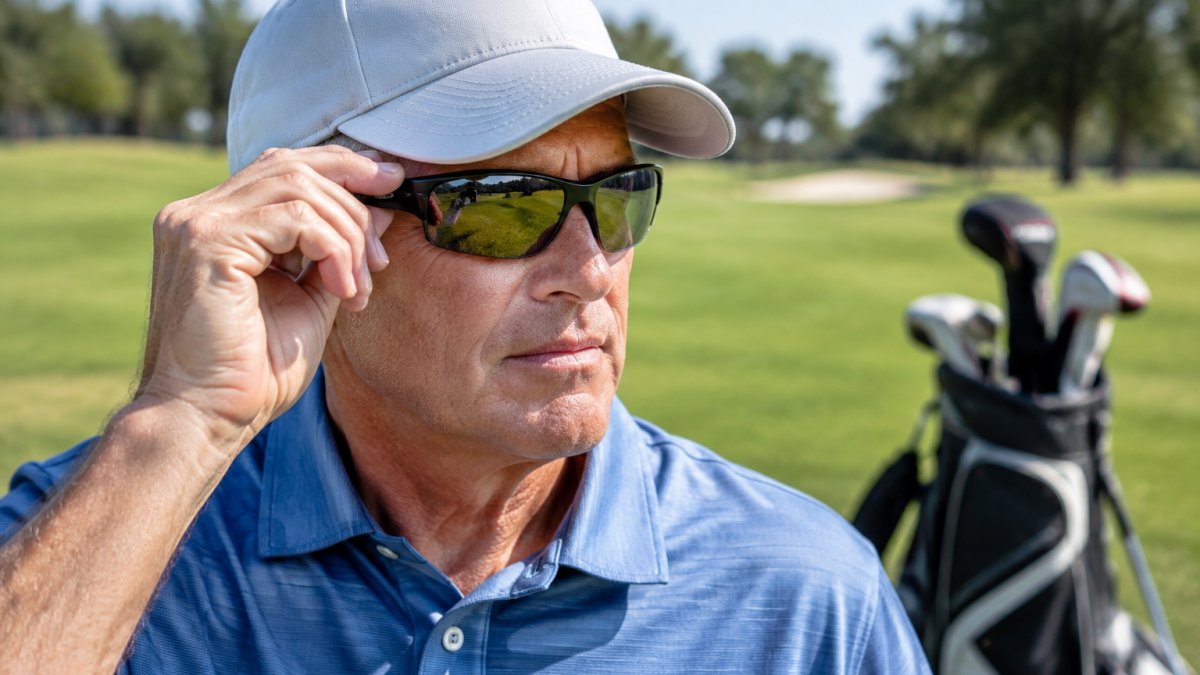
Three details matter more than anything on the spec sheet. Temple arms thin enough to sit under a cap without pressure. A frame material that flexes and returns to shape. And a size that matches your face width, not one adjusted to fit everyone.
A common mistake is buying a frame built for a broad face and tightening it. It will not stay put. Our fit guide maps face width and cap wearing to specific frames so you start from the right size instead of correcting the wrong one.
The Best Prescription Glasses for Golf: Picking the Right Pair
Start with your face, then your prescription, then your lens. Narrow or smaller faces should look at Rambo Slim or Gimme, both designed for smaller or narrower facial features. Medium to large faces may prefer Club Champ or Dormie.
Club Champ suits players who want reduced peripheral glare, with side wings that block horizontal light and reflections. Dormie suits long rounds, with sloped temples and extended temple length for grip without pressure. Rambo is the versatile choice if you want one pair from fairway to clubhouse.
For players ready to choose, browse our golf sunglasses collection, including prescription styles in men's and women's fits.
Ordering Prescription Golf Glasses That Fit Right the First Time
Ordering online is easier when you have your current prescription and your face width.
- Request your prescription from your eye doctor, including pupillary distance
- Measure your face width or compare against a frame you already own
- Confirm the frame has enough lens height for progressives
- Choose a contrast tint suited to your typical course conditions
- Check the return policy before you order
The American Optometric Association's guidance on regular eye exams is worth reading before you order, since an outdated prescription undermines every other choice. The FDA's rules on prescription eyewear also clarify what documentation a seller should require.
Your vision is not getting younger, but your equipment can keep up with it. JONDOSPORT USA builds golf eyewear with KRISP lens technology for contrast and depth perception, non-polarized lenses that preserve green reading, and frames sized for specific faces so they stay put through your swing. Get started with JONDOSPORT USA and see the line more clearly on your next round.
Frequently Asked Questions
Is there such a thing as prescription golf glasses?
Yes. Prescription golf glasses are sport frames built with your vision correction in the lenses, so you get glare reduction and contrast without wearing contacts or clip-ons. Brands like JONDOSPORT offer prescription options in golf-specific frames, including non-polarized lens choices. You will need a current eyeglass prescription, and you should confirm the frame you choose supports your prescription strength, especially if you wear progressives.
Do golf glasses actually help you see the ball?
High-contrast lenses can make a white ball stand out against sky and turf, which helps with tracking flight and spotting the ball in the rough. The effect depends on lens tint and light conditions. A tint that boosts contrast in bright sun may be too dark on overcast days. Non-polarized, contrast-enhancing lenses are generally preferred for golf because they keep depth cues intact while reducing glare.
Are polarized sunglasses a good choice for golf?
Polarized lenses cut glare from water and windshields, but on the course they can flatten depth perception and make it harder to read subtle breaks in the green. Many golfers prefer non-polarized lenses for that reason. If you play in extreme glare conditions, polarized can work, but test them on a putting green before committing to a prescription pair.
Can you get progressive lenses in prescription golf glasses?
Sport frames with a high wrap and curvature can limit how wide the reading corridor is for progressive lenses. If you need to read a scorecard and see distance markers, ask whether the frame supports a progressive or bifocal prescription before ordering. A flatter, less wrapped frame usually gives a more usable progressive corridor than a highly curved sport frame.
What lens tint is best for golf?
Amber, brown, and rose tints boost contrast against green turf and are popular for golf. Gray tints reduce overall brightness without shifting color much, which suits very bright days. For changing light, a lighter contrast tint works better than a dark one. Match the tint to your typical tee time and sky conditions rather than buying one pair for every round.
Does Medicare pay anything on glasses for seniors?
Check your specific plan documents before assuming any reimbursement for prescription eyewear.



